📍 UPDATED FOR 2026 · BISP BENAZIR KAFAALAT
8171 Web Portal: The No-Nonsense Guide to Checking Your BISP CNIC Status
If you’ve been typing your CNIC into random “8171 check online” sites and getting weird results, this guide sorts out what’s real, what’s not, and exactly how the official portal works — explained plainly, with sources, not the way a government notice reads.
Check your eligibility on the official BISP portal
This button takes you straight to BISP’s own secure portal — 8171.bisp.gov.pk. We don’t collect, store, or see your CNIC on this page; nobody except NADRA and BISP should ever ask for it.
- 100% based on official BISP & NADRA sources
- Free to use — no fee, ever, for a CNIC check
- Reviewed & updated — August 2026
- Every figure below is sourced and dated
START HERE
What Exactly Is the 8171 Web Portal?
Let’s get one thing straight before anything else: “8171” isn’t a website, a company, or a person’s name. It’s a number — a government SMS short-code that the Benazir Income Support Programme (BISP) uses so that people across Pakistan, from a village outside Muzaffargarh to a flat in Karachi, can text their CNIC number and find out in seconds whether they qualify for the Benazir Kafaalat cash stipend. Over time, “8171” also became shorthand for the website version of that same check — the official 8171.bisp.gov.pk portal, where you type your CNIC and a captcha code instead of sending a text.
That’s really it. There’s no separate “8171 company,” no app you’re required to download, and definitely no fee involved. If somewhere along the way you were asked to pay a fee to “activate” your 8171 status, you were dealing with a scammer, not BISP — more on that a little later, because it genuinely matters.
This guide sticks to what’s verifiable: official BISP statements, NADRA’s own guidance, and reporting from outlets that checked their facts before publishing — not the copy-pasted wording you’ll find on a lot of look-alike sites.
WHAT PEOPLE SEARCH FOR
Other Ways People Search for the Same Thing
“8171 portal” isn’t the only phrase people type in — the same official check gets searched under a lot of different names. If you arrived here through one of these, you’re in the right place:
- 8171 web portal
- 8171 check online
- BISP 8171 check online CNIC
- Ehsaas 8171 program check
- 8171.bisp.gov.pk login
- 8171 CNIC check 2026
- BISP Kafaalat 8171 status
- 8171 web portal 25000 update
- 8171 new update today
- BISP payment schedule 2026
- 8171 registration online
- 8171 helpline number 0800-26477
All of these point to the same underlying system — BISP’s official 8171 SMS/web check — just phrased differently depending on whether someone remembers “Ehsaas,” “BISP,” or just the number itself.
BACKSTORY
A Quick History: Why “8171” Became a Household Number in Pakistan
BISP itself was established in 2008, originally as a response to a food-price and economic crisis that hit low-income households hardest. For years, finding out whether your family qualified meant physically visiting an office, standing in a queue, and often not getting a clear answer for weeks. The 8171 short-code was introduced specifically to cut that waiting period down to seconds — you send one SMS, and the system checks your CNIC against the NSER database instantly.
Between 2019 and 2022, the government layered the “Ehsaas” brand on top of BISP’s existing work, bundling in additional initiatives like educational stipends and health cards. That’s the era a lot of older signage, pamphlets, and even some government letterheads still reference. When the branding shifted back toward “BISP” as the primary name in more recent years, the number itself — 8171 — never changed. Whatever the programme is called this year, the verification channel has stayed the same since it launched, which is exactly why it’s worth memorising the real domain instead of whatever branded name is trending on social media this month.
That continuity also explains why so many unofficial sites can get away with sounding credible — they borrow real BISP and Ehsaas terminology, mix in a plausible-looking design, and rank for searches from people who don’t know which brand name is current. Knowing the timeline yourself is a small but real defence against that confusion.
NAMING CONFUSION
BISP, Ehsaas, and Benazir Kafaalat — Sorting Out the Names
This trips up more people than you’d think, so let’s untangle it once and for all.
BISP
The organisation. Benazir Income Support Programme — a federal statutory body that has run Pakistan’s largest cash-transfer safety net since 2008.
Ehsaas
An umbrella brand used between 2019–2022 for various poverty-alleviation programmes under BISP’s administration. Still seen on older signage and forms.
Kafaalat
The specific quarterly cash programme most people mean when they say “8171 payment” — targeted mainly at women heads of eligible households.
So when someone says “check my Ehsaas 8171 status,” they usually mean checking their Benazir Kafaalat eligibility through the 8171 system that BISP runs. Same programme, different labels stuck to it at different times.
Don’t Confuse Kafaalat With BISP’s Other Programmes
BISP doesn’t run just one scheme — Kafaalat is the flagship cash-transfer programme, but it sits alongside a few others people often lump together when they talk about “8171 payments.” Knowing which one applies to you saves confusion at the Tehsil office counter.
| Programme | What it actually covers | Checked via 8171? |
|---|---|---|
| Benazir Kafaalat | Quarterly unconditional cash stipend for eligible women heads of household. | Yes — this is the primary result you’ll see. |
| Benazir Nashonuma | Nutrition-focused stipend for pregnant/breastfeeding women and children under two, tied to health check-ins. | Partially — enrolment happens at health centres. |
| Benazir Taleemi Wazaif | Conditional cash support tied to school enrolment and attendance for children in Kafaalat households. | Indirectly — linked to your existing Kafaalat record. |
| Benazir Hunarmand | Skills-training initiative for youth from beneficiary households — not a cash stipend. | No — applied for separately. |
If your 8171 result only mentions Kafaalat and nothing about your children’s school stipend, that’s normal — it isn’t a sign anything’s wrong. Those additional programmes are usually confirmed separately, often at the same Tehsil office where your original registration happened.
THREE WAYS IN
Three Official Ways to Check Your 8171 Status
BISP never limited this to one channel, which makes sense given how many people in rural areas don’t have reliable internet. Here’s how the three official methods compare:
| Method | How it works | Best for | Cost |
|---|---|---|---|
| SMS to 8171 | Text your 13-digit CNIC (no dashes) to 8171 from your own registered mobile number. | Weak-internet areas; no smartphone. | Standard SMS charge only. |
| Web Portal | Visit 8171.bisp.gov.pk, enter your CNIC and the captcha shown on screen. | Anyone with a phone/computer; you can screenshot the result. | Free. |
| Helpline | Call 0800-26477, Monday to Friday, 9am–5pm. | Unclear results or reporting a problem. | Free (toll-free). |
A quiet tip that isn’t written on any government poster: the SMS method is usually the most reliable if 8171.bisp.gov.pk loads slowly, because the server handling millions of hits during peak announcement periods can genuinely lag.
WALKTHROUGH
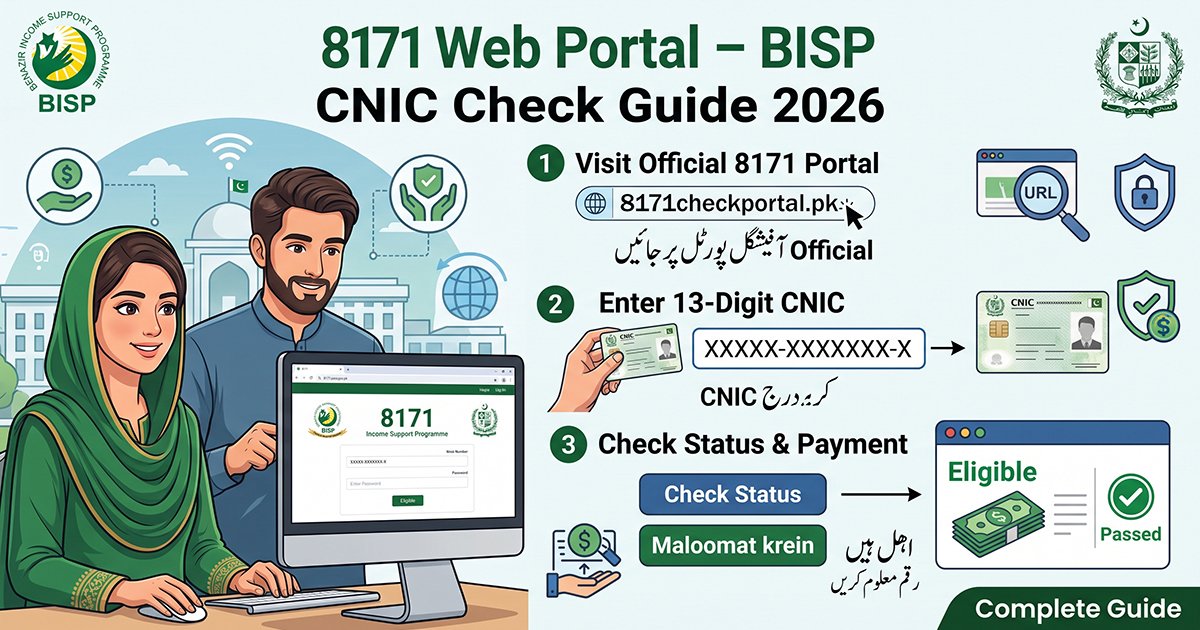
Step-by-Step: How to Check Your CNIC on 8171.bisp.gov.pk
- Go to the real address. Type 8171.bisp.gov.pk into your browser yourself, or use the button above. Don’t tap a link from a random WhatsApp forward.
- Enter your CNIC number exactly as printed on your card, 13 digits — the field usually auto-formats it.
- Type the captcha code shown in the image box. Use the refresh icon if it’s unclear; some portals temporarily lock repeated failed attempts.
- Submit and read the result carefully. Eligible & receiving payment, eligible but pending, not eligible by NSER score, or “not registered.”
- Screenshot or note the result — useful if you plan to visit a BISP Tehsil office afterward.
One more thing worth knowing: the portal occasionally shows a message about your household needing biometric re-verification even when your original registration was fine. That’s not an error on your end — BISP periodically re-verifies existing beneficiaries against NADRA’s biometric database to keep the beneficiary list accurate. If you see that message, the fix is a short visit to a designated verification point, not a resubmission of your CNIC online.
TIMING
Why Disbursement Dates Differ by Region
Payments don’t land for every beneficiary on the same calendar day, even within the same quarter. BISP releases funds in phases, and each province — sometimes each district — gets processed on a rolling schedule. Punjab districts might start receiving payment notifications a full week before parts of Balochistan or interior Sindh, purely because of how disbursement batches are staged, not preferential treatment. If a neighbour in another city already got their notification and you haven’t, that alone isn’t cause for alarm — check your own status on the portal before assuming a problem specific to your file.
ELIGIBILITY
Who Is Actually Eligible for Benazir Kafaalat?
Eligibility isn’t decided by the 8171 system itself — it’s decided by your household’s score in the National Socio-Economic Registry (NSER), the nationwide poverty survey BISP runs periodically. The 8171 check simply shows you the result of that scoring. A lot of people assume texting 8171 somehow “applies” them — it doesn’t. You need to have already been surveyed, or register at a BISP Tehsil office / NSER registration desk first.
| Criteria | Detail |
|---|---|
| Household survey | Must have a completed NSER household survey on record, via door-to-door enumeration or a registration desk. |
| Poverty score | Household falls below the BISP-defined poverty threshold calculated through the Proxy Means Test (PMT). |
| Primary applicant | Typically the adult woman of the household, registered with her own valid CNIC. |
| CNIC status | Must be a valid, non-expired NADRA CNIC — an expired card is one of the most common reasons a genuinely eligible family shows “ineligible.” |
| Re-verification | Current beneficiaries occasionally need biometric re-verification at designated centres to keep receiving payments. |
If your family has never been surveyed, checking 8171 will simply tell you that — it’s not a rejection, it just means there’s no record yet. The next step is visiting your nearest BISP Tehsil office to request registration, not repeatedly refreshing a website.
People also ask why two households that look equally poor from the outside get different results. The PMT scoring model weighs household assets, number of earning members, housing structure, land ownership and a few other factors into a single composite score, so two families can differ on paper even when their day-to-day circumstances look similar. If you believe your household’s score doesn’t reflect your real situation, BISP allows a complaint and re-verification process through the Tehsil office.
PAYMENTS
How Much Money Do You Actually Get?
This is the part with the most misinformation floating around, so here’s what’s actually been announced, in order, with sources attached rather than a number repeated because it sounds current.
| Period | Quarterly stipend | Source |
|---|---|---|
| Before January 2025 | Rs. 10,500 | Caretaker government adjustment, previous cycle |
| January 2025 onward | Rs. 13,500 | The Nation · Aaj News |
| Later in FY2025–26 | Rs. 14,500 | Reported ahead of the FY27 budget cycle; confirm your own instalment on the portal. |
| Proposed from Jan 2027 | Rs. 18,000 (pending approval) | Part of the proposed FY2026–27 federal budget — not guaranteed until formally passed. |
Notice “quarterly” — Kafaalat is paid every three months, not monthly, which confuses first-time beneficiaries who expect a payment every 30 days. BISP’s overall federal allocation has also grown substantially — from roughly Rs. 471 billion to over Rs. 716 billion in recent budget cycles — which is the underlying reason these increases keep happening. Verify this against BISP’s own news page whenever a new cycle is announced.
Because budget figures and rollout dates shift between provinces and disbursement phases, treat the exact rupee amount here as a snapshot of what’s been publicly reported — always confirm your own instalment directly on the 8171 portal or at a BISP office.
Payments are typically disbursed through designated bank branches, mobile wallet partners, or BISP’s own payment agents, depending on what’s rolled out in your district. In mid-2025, BISP began piloting a mobile wallet payment model with support from the EU and Germany, aimed at reducing the long queues that used to form at disbursement points. If your area has moved to this system, you may receive an SMS notification directing you to a specific agent or wallet rather than a bank branch — that’s a legitimate part of the rollout, as long as the notification traces back to your registered BISP record and doesn’t ask for banking details upfront.
BEFORE YOU START
Documents You Need Before You Start
| Document | Why it matters |
|---|---|
| Original valid CNIC | Required for the check itself and mandatory at any physical BISP office visit. |
| Registered mobile number | Needed for the SMS method and any OTP-based re-verification. |
| Marriage/B-Form/Divorce certificate | Used to confirm household composition during registration or updates. |
| Proof of residence | Sometimes requested during NSER survey updates or dispute resolution. |
Nothing exotic here — but the number of people turned away from a Tehsil office because their CNIC had quietly expired six months earlier is higher than you’d expect. Check the expiry date on your card before you make the trip.
GLOSSARY
Quick Glossary: Terms Used in This Guide
A handful of abbreviations show up again and again across BISP paperwork and this guide. Here’s what each one actually means, in plain language:
| Term | What it means |
|---|---|
| NSER | National Socio-Economic Registry — the nationwide household survey BISP uses to decide who qualifies for support. |
| PMT | Proxy Means Test — the scoring formula applied to your NSER survey answers to calculate a poverty score. |
| NADRA | National Database & Registration Authority — the body that issues your CNIC and verifies identity for BISP. |
| CNIC | Computerised National Identity Card — the 13-digit ID number every check on this portal is tied to. |
| Tehsil office | The local BISP administrative office where in-person registration, disputes, and updates are handled. |
| Biometric re-verification | A periodic fingerprint check against NADRA’s database to confirm an existing beneficiary is still the right person. |
WHO THIS IS FOR
Who Should Use This Page
- Beneficiaries who already receive Benazir Kafaalat and want to confirm this quarter's status.
- Families who suspect they qualify but have never been surveyed under NSER.
- Anyone who searched “8171 portal,” “8171 check online,” or “BISP 8171” and wants a straight answer, not another copy-pasted page.
- People who received a suspicious SMS or call claiming to be from BISP and want to check if it's genuine.
- Journalists, researchers, or students who need a sourced, plain-language summary of how the 8171 system works.
REAL TALK
Mistakes I See People Make With 8171 All the Time
A few patterns keep repeating, so let’s go through them honestly instead of pretending the process is flawless.
SAFETY FIRST
How to Spot a Fake 8171 Website
This isn’t a hypothetical risk — Pakistani outlets have published specific warnings about it. Pakistan Observer ran a piece plainly titled “these 8171 portals are not from BISP or Ehsaas,” and PhoneWorld documented a whole cluster of look-alike sites built around this exact keyword, misleading people searching for genuine help.
You may also have seen posts mentioning a second number, “7181,” described as an alternate BISP code. As of this writing, BISP’s own published materials only name 8171 as the official channel, alongside the toll-free helpline 0800-26477. Treat “7181” and similar variants circulating on social media as unverified until BISP itself confirms them.
None of this means you should be scared of the internet — it means you should be specific about which address you trust. Bookmark 8171.bisp.gov.pk once, use that bookmark every time, and you’ve closed the door on this entire category of scam.
IF SOMETHING GOES WRONG
Payment Not Received? Here's What To Do
- Re-check your status on 8171.bisp.gov.pk to confirm you’re still marked as an active, eligible beneficiary.
- Call the helpline on 0800-26477 during working hours with your CNIC ready — they can tell you whether the delay is regional or specific to your file.
- Visit your nearest BISP Tehsil office in person if the phone line doesn’t resolve it. Bring your CNIC and a screenshot of your portal result if you have it.
- Ask about biometric re-verification — a surprising number of “missing payments” turn out to be a lapsed biometric check rather than an actual removal from the programme.
QUESTIONS PEOPLE ACTUALLY ASK
Frequently Asked Questions About the 8171 Web Portal
About This Guide
This page is written and maintained by the 8171 Web Portal editorial team, and every fact in it is cross-checked against BISP’s own announcements and independent Pakistani news reporting rather than repeated from other unofficial sites. Where a number could change with the federal budget, we say so explicitly and link to the source.
Last reviewed: 21 August 2026 • Next scheduled review: after the next BISP budget announcement.
Final Thoughts on Using the 8171 Web Portal
At the end of the day, this whole system boils down to three things: your CNIC has to be valid, your household needs to be on record with NSER, and you should only ever trust one domain — bisp.gov.pk — for anything to do with your result. Everything else on this page is the detail around those three facts: how to check, what the payment history has actually looked like, what documents to keep handy, and which red flags mean a site isn’t real. If you take nothing else from this guide: the scam sites built around “8171” are a documented, reported problem, not a rare edge case, and a five-second glance at the address bar is usually all it takes to protect yourself.
This guide references official statements and news coverage from bisp.gov.pk, The Nation, Aaj News, Pakistan Observer, PhoneWorld, and Wikipedia’s BISP overview. Payment figures are subject to change with each federal budget cycle — always confirm your own instalment directly on the official portal.
A note on why this page exists: there’s a lot of low-quality, copy-pasted content built around the “8171” search term, some of it actively misleading or designed to collect personal information it has no business asking for. This guide was put together by cross-checking BISP’s own announcements against independent news reporting. If you spot something here that’s gone out of date — payment figures especially — the official portal and helpline listed above always take priority over anything written on this page.