If your 8171 payment not received problem has dragged on for more than a few days, you are far from alone. A BISP payment not received message after your status already shows “eligible” is one of the most common complaints of 2026, and it almost always has a specific, fixable cause. This guide picks up exactly where a status check leaves off: run one quick 8171 payment check at home, work through the reasons below, and you will know whether your money is genuinely stuck or simply waiting for your district’s turn in the payment cycle.
8171 Payment Not Received: Common Reasons for the Delay
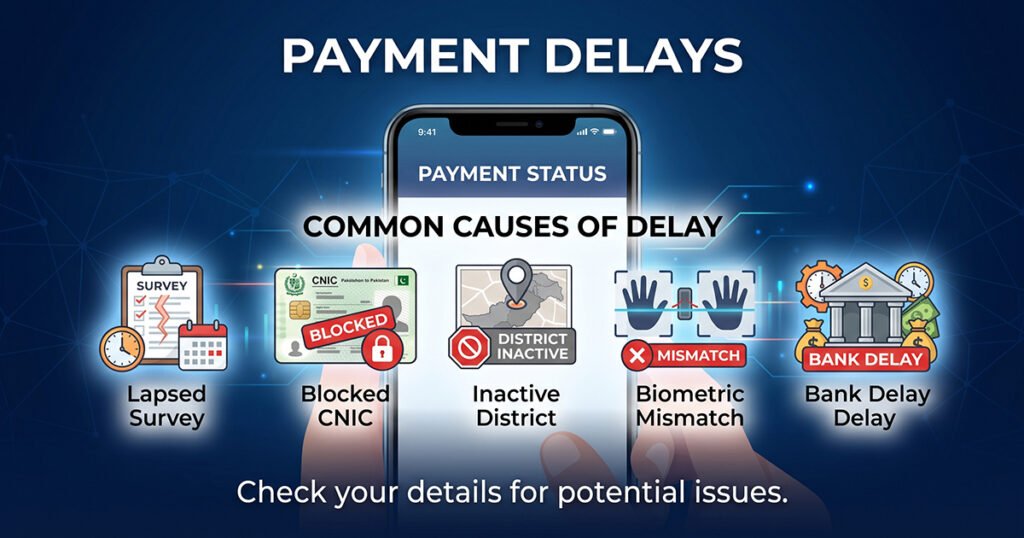
There are a handful of well-documented causes behind an 8171 payment not received case. Working through these first will save you a wasted trip to a Tehsil office.
- Lapsed or outdated survey data. If your NSER survey information is more than a couple of years old, or your household details have changed (marriage, new dependents, a new address), your file may be flagged for re-verification before funds are released.
- Blocked or flagged CNIC. A CNIC can be temporarily blocked if there is a mismatch with NADRA records, a biometric verification failure, or a fraud-prevention flag triggered by unusual account activity.
- District not yet active for this cycle. BISP releases payments in phases by district rather than nationwide at once, so your area may simply not have opened for the current quarter yet. This is the single most common reason behind an 8171 payment not received complaint.
- Biometric mismatch at the payment point. Even after eligibility is confirmed, a fingerprint that does not match the record on file at the withdrawal point will block the transaction until it is resolved.
- Bank or retailer-side processing delay. Sometimes the delay is not on BISP’s end at all — HBL Konnect or a retailer’s system backlog can hold up disbursement by a few days.
- Payment already collected by someone else. If a family member withdrew on your behalf, your BISP payment not received assumption may be wrong; the quarter’s instalment is closed and the next one is due in the following cycle.
What to Check First: Run a Quick 8171 Payment Check
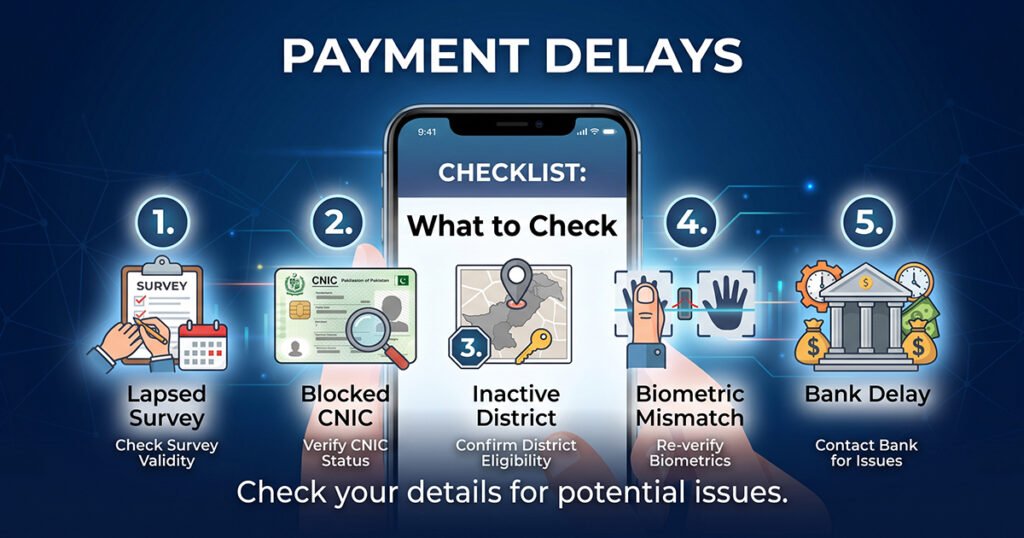
Before assuming your 8171 payment not received issue needs an office visit, run this five-minute 8171 payment check from home:
- Recheck your eligibility status through the 8171 web portal or SMS and confirm your household is marked eligible for the current quarter, not just a past one.
- Confirm your district’s active phase. If your district has not opened yet for this quarter, there is nothing to troubleshoot — you simply need to wait.
- Verify your CNIC has not expired or been reissued recently. A reissued CNIC takes time to sync with the BISP database, which looks identical to a payment delay from the outside.
- Check for an SMS you may have missed about a required re-survey or a biometric re-verification appointment.
- Try a different withdrawal point if collection already failed once — some retailer terminals have far higher biometric failure rates than bank branches.
Start with an 8171 payment status check so you know exactly what the system says about your household before you go any further. If your survey data has not been updated in a while, this is also the moment to read our BISP Dynamic Survey guide, because a lapsed survey is one of the most common hidden causes of an 8171 payment not received case that looks like a simple delay from the outside.
BISP Payment Not Received After Approval: What It Actually Means
Eligibility and disbursement are two separate stages, and confusing them is why so many people report a BISP payment not received problem that is not really a problem yet. Being marked eligible means your household has cleared the PMT score threshold and is in the programme. It does not mean the quarter’s funds have been released to your district, that your biometric record has been verified at a payment point, or that the retailer’s system has your transaction ready.
In other words, an 8171 payment not received status in week one of a new cycle is normal. The same status six weeks in, with an active district and an approved CNIC, is a genuine issue worth escalating.
How Long Is a Normal Delay?
Use this table to judge whether your 8171 payment not received case needs action yet:
| Situation | Normal wait | What to do |
|---|---|---|
| District not yet active | Up to 4–6 weeks into the quarter | Wait; repeat your 8171 payment check weekly |
| District active, status eligible | 3–14 days | Wait, then call the helpline |
| Biometric failed once | Same day | Retry at a bank branch instead of a retailer |
| CNIC blocked or flagged | Does not clear by itself | Visit a Tehsil office with your original CNIC |
| Re-survey SMS received | 2–8 weeks after the survey | Complete the NSER update first |
When to Contact BISP or Visit a Tehsil Office
Some 8171 payment not received cases genuinely cannot be resolved from home. It is time to contact BISP directly if:
- Your district is active, your eligibility shows approved, and more than two weeks have passed with no payment.
- Your CNIC shows as blocked or flagged when you check your status.
- Withdrawal failed due to a biometric mismatch more than once.
- You suspect your NSER survey data needs correction rather than just an update.
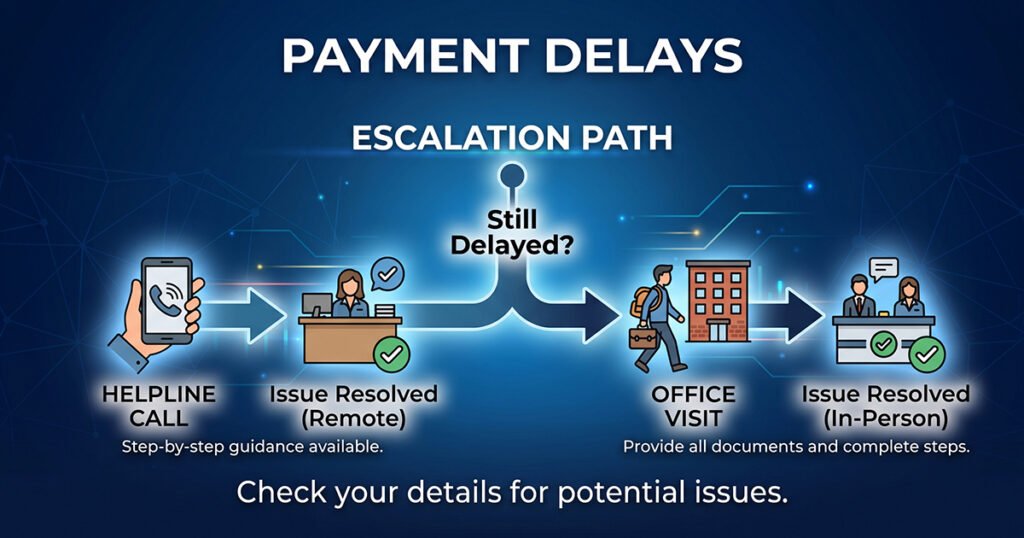
There are two ways to escalate an 8171 payment not received complaint:
- Call the BISP helpline at 0800-26477 and give your CNIC. Staff can look directly into your file and tell you the exact reason for the hold instead of you guessing from the list above.
- Visit your nearest BISP Tehsil office in person with your original CNIC, a photocopy, and any prior payment confirmation or SMS reply. You can find office locations and official notices on the official BISP website.
Bringing documentation speeds up the visit considerably — staff can often clear a flagged CNIC or a biometric mismatch on the spot if you have the right paperwork with you.
How to Avoid an 8171 Payment Not Received Problem Next Quarter
Most repeat 8171 payment not received cases come down to stale data rather than a system fault. Keep your NSER record current, update BISP whenever your household composition or address changes, and re-verify your biometrics at a bank branch once a year. Knowing the 2026 instalment amount and payment schedule also helps, because you will know when your money is actually due rather than checking every day.
Finally, bookmark the 8171 web portal and run a quick 8171 payment check at the start of every quarter. Catching a blocked CNIC early is far easier than chasing a BISP payment not received case after the disbursement window has already closed.
5 thoughts on “BISP 8171 Payment Not Received in 2026? Here’s What to Do”