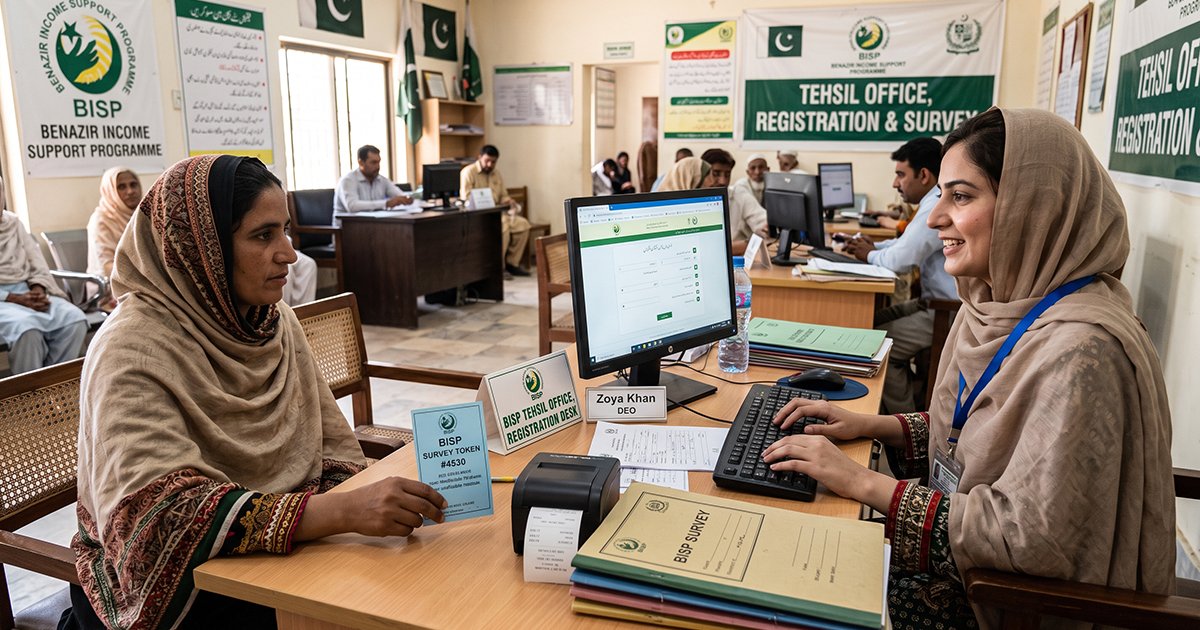
Confirmed eligible but still not getting paid? A lapsed BISP dynamic survey record is one of the most common — and least talked about — reasons a payment quietly stalls even after everything else checks out. This 2026 guide shows you exactly how to update NSER record details at your Tehsil office, what an NSER survey update actually changes behind the scenes, and how long it takes before your money moves again.
Table of Contents
- What Is the BISP Dynamic Survey (NSER)?
- Why an Outdated Record Blocks Your Payment
- Who Needs an NSER Survey Update?
- How to Update NSER Record: 5 Steps
- Documents You Need to Bring
- NSER Survey Update Timeline
- Mistakes to Avoid
- Frequently Asked Questions
What Is the BISP Dynamic Survey (NSER)?
The National Socio-Economic Registry (NSER) is BISP’s core database, built from door-to-door poverty surveys that record household details like income sources, assets, and living conditions. For years this registry was static — refreshed only during large national surveys held every few years.
The BISP dynamic survey (sometimes referenced by the form code HH6) changed that. Instead of waiting years for the next national resurvey, a household can now request an NSER survey update whenever its circumstances genuinely change. In practical terms, that means you can update NSER record information the same month your situation changes rather than being stuck with outdated data until the next scheduled rollout.
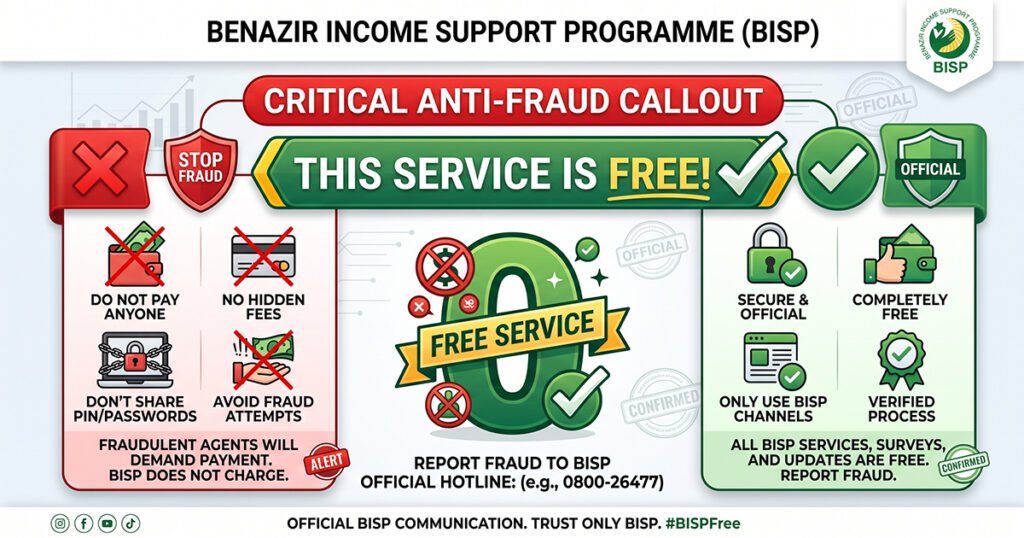
The survey is conducted free of charge at every stage. BISP has repeatedly warned through its official website that anyone charging a fee for this service is acting fraudulently, and beneficiaries should rely only on official BISP channels.
Why an Outdated Record Blocks Your Payment
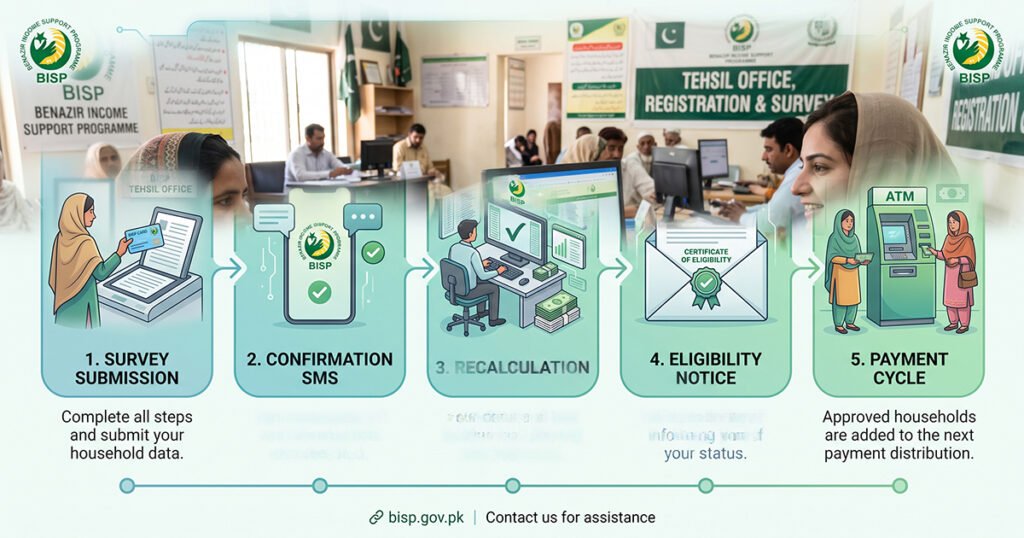
Here is the part that catches people off guard: your PMT score and eligibility status are only as accurate as the data behind them. If your last survey was recorded years ago, your file may no longer reflect your actual household situation, and BISP’s system can flag the record for review before releasing funds.
An NSER survey update rewrites that underlying data set. Once you update NSER record entries for income, dependants, and assets, the system recalculates your poverty score from the corrected figures instead of the stale ones. That single step is why so many blocked files start moving again once the household takes the time to correct its file properly. If you want to understand exactly how those figures translate into a score, our PMT score explainer breaks down the calculation itself — this guide focuses on getting the underlying data current.
Who Needs an NSER Survey Update?
Not every stalled payment traces back to survey data. These are the situations where a dynamic survey is genuinely the right fix:
- A significant time gap since your last recorded survey, especially if it predates a recent national resurvey cycle.
- A change in household composition — marriage, the birth of a child, the death of a household member, or a change in who counts as household head.
- A change in employment status within the household, which feeds directly into the PMT calculation.
- A move to a different address or district, which can create a mismatch between your registered location and where you are trying to collect payment.
- Wrong or incomplete data captured by the original surveyor — a common reason people update NSER record entries even when nothing in their life has changed.
If your CNIC is being rejected outright rather than showing a low score, an NSER survey update is not the answer — see our guide on 8171 CNIC not found errors first.
How to Update NSER Record: 5 Steps
Requesting a BISP dynamic survey is a straightforward, in-person process. There is no online form and no SMS shortcut — the update must be recorded at a BISP office. Here is what to expect:
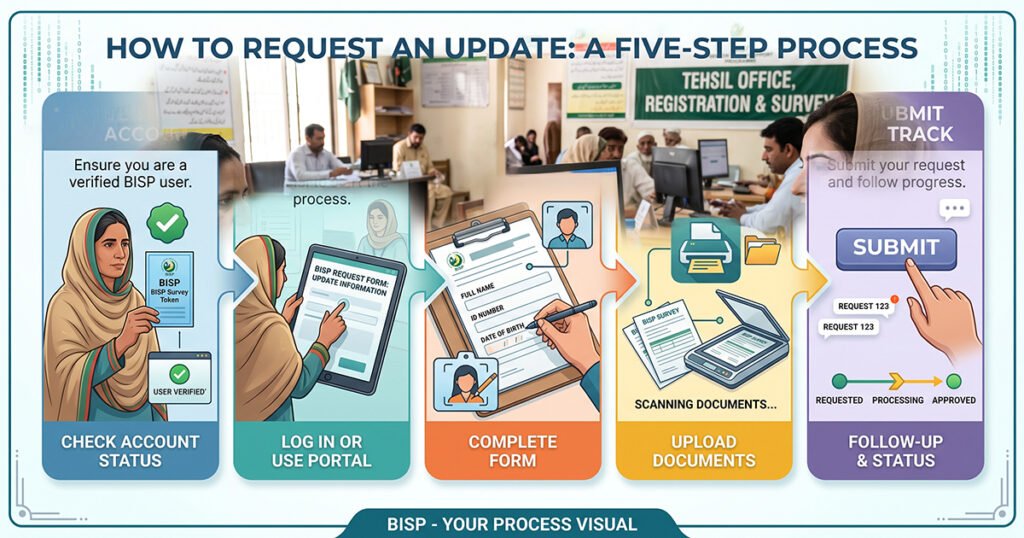
- Visit your nearest BISP Tehsil office with your original CNIC. Bring a photocopy as well, since staff may need to retain one.
- Take a survey token on arrival and wait for your turn. Offices get busy, particularly right after a new eligibility announcement.
- Complete the structured interview with a data entry operator, who works through socio-economic questions covering household size, income, assets, and living conditions. Answer honestly — this interview is what actually lets BISP update NSER record figures on your file.
- Verify your identity via thumbprint, which ties the NSER survey update to the biometric data already on your file.
- Wait for the confirmation SMS from 8171 confirming that the BISP dynamic survey has been submitted and recorded.
There is no fee at any stage. If anyone asks for payment to “process” your survey or “guarantee” eligibility, that is not an official BISP procedure and should be reported.
Documents Required for the BISP Dynamic Survey
Turning up prepared saves a second trip. Bring the following to update NSER record details in one visit:
- Original valid CNIC of the woman registered as head of the household, plus one photocopy.
- B-Form or CNIC numbers for children and other dependants living in the home.
- A registered mobile number in your own name, so the 8171 confirmation SMS reaches you.
- Any document showing your current address if you have moved since the last BISP dynamic survey.
- Death certificate or marriage certificate where household composition has changed.
Staff cannot update NSER record entries for a household without the CNIC of the registered woman present, so plan the visit around her availability rather than sending a relative.
NSER Survey Update Timeline: What to Expect
Once your BISP dynamic survey is submitted, do not expect an instant change in payment status. A realistic NSER survey update timeline looks like this:
- Confirmation SMS — usually arrives shortly after the office visit, confirming the survey was recorded.
- Score recalculation — several days to a few weeks, depending on processing volume at BISP.
- Eligibility notification — if the corrected data produces a qualifying score, a further message follows once the decision is finalised.
- Payment release — still follows the normal quarterly, district-by-district disbursement cycle. Check the current BISP installment amount and payment schedule so you know when your district is due.
If more than a month passes with no confirmation message, call the BISP helpline and ask for the status of your specific submission. You can also check your 8171 payment status online at any point after you update NSER record information, and our guide on what to do when BISP payment is not received covers the next escalation steps.
Mistakes to Avoid
Four things quietly cost people weeks after a BISP dynamic survey:
- Paying an agent. Every survey update is free. Money changing hands is the clearest sign you are being scammed.
- Understating or overstating income. The interview is cross-checked against other records, and a mismatch can suspend the file rather than fix it.
- Using someone else’s mobile number. The 8171 confirmation will go to that phone, not yours.
- Repeating the survey too soon. One BISP dynamic survey per genuine change of circumstance is enough; duplicate requests do not speed up recalculation.
Households with a pregnant woman or a child under two should also check the Benazir Nashonuma Program eligibility rules, since that stipend is assessed from the same NSER data you have just corrected.
6 thoughts on “BISP Dynamic Survey 2026: How to Update NSER Record”