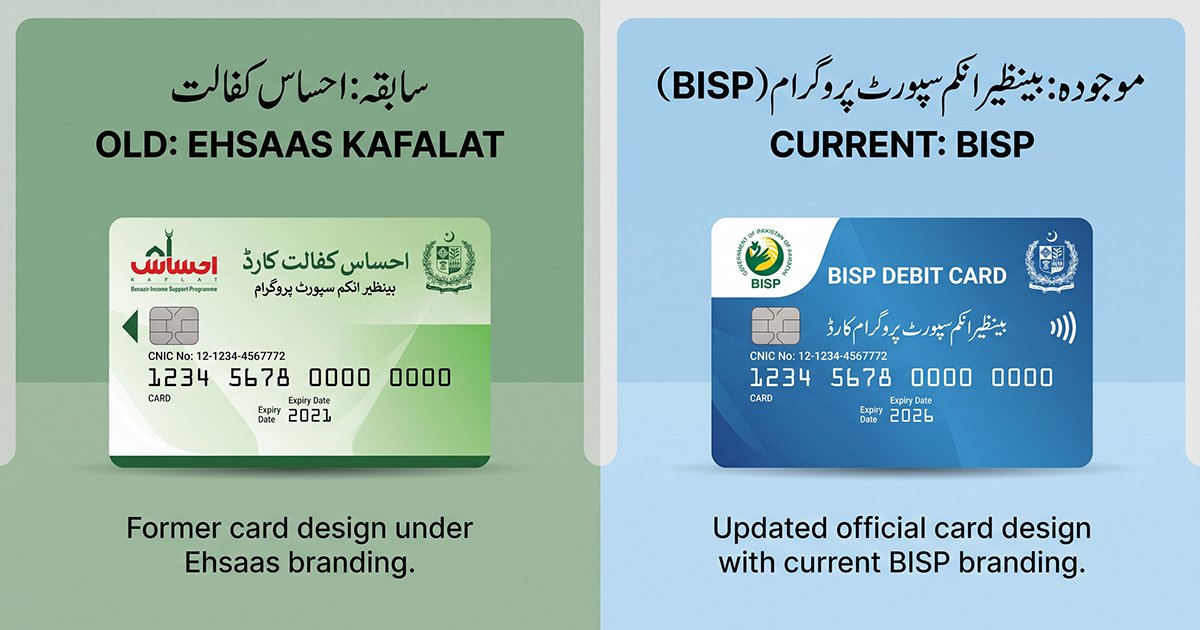
Ehsaas Kafalat vs BISP Kafalat 2026: Is Ehsaas Still Active?
Search online and you will see both “Ehsaas Kafalat” and “BISP Kafalat 2026” used to describe what looks like the same cash assistance programme — sometimes on the very same page. So what is the real difference in Ehsaas Kafalat vs BISP Kafalat, and is Ehsaas still active in 2026? The short answer: it is one programme under two names, and BISP Kafalat 2026 is the name you should be searching today.
In this guide:
- Ehsaas Kafalat vs BISP Kafalat: the quick answer
- From Ehsaas Kafalat to BISP Kafalat 2026
- What actually changed in BISP Kafalat 2026
- Is Ehsaas still active in 2026?
- How to check your BISP Kafalat 2026 status
- Which Ehsaas programmes carried over
- Who qualifies for BISP Kafalat 2026
- How payments are delivered
- Enrolled under Ehsaas but not being paid?
- Common mistakes when searching for Ehsaas Kafalat
- Key takeaways
Ehsaas Kafalat vs BISP Kafalat: The Quick Answer
If you read only one section, read this one. “Ehsaas Kafalat” was the 2019–2022 brand name for the exact same monthly stipend that is called BISP Kafalat 2026 today. The eligibility rules, the household database and the payment channels did not change when the name did.
| Point of comparison | Ehsaas Kafalat (2019–2022) | BISP Kafalat 2026 |
|---|---|---|
| Umbrella brand name | Ehsaas | BISP |
| Institution actually running it | BISP | BISP |
| How eligibility is decided | PMT score from the NSER survey | PMT score from the NSER survey |
| Where you check your status | 8171 SMS and web portal | 8171 SMS and web portal |
| Name to use in 2026 | Historical / legacy only | Current official name |
A Quick History: From Ehsaas Kafalat to BISP Kafalat 2026
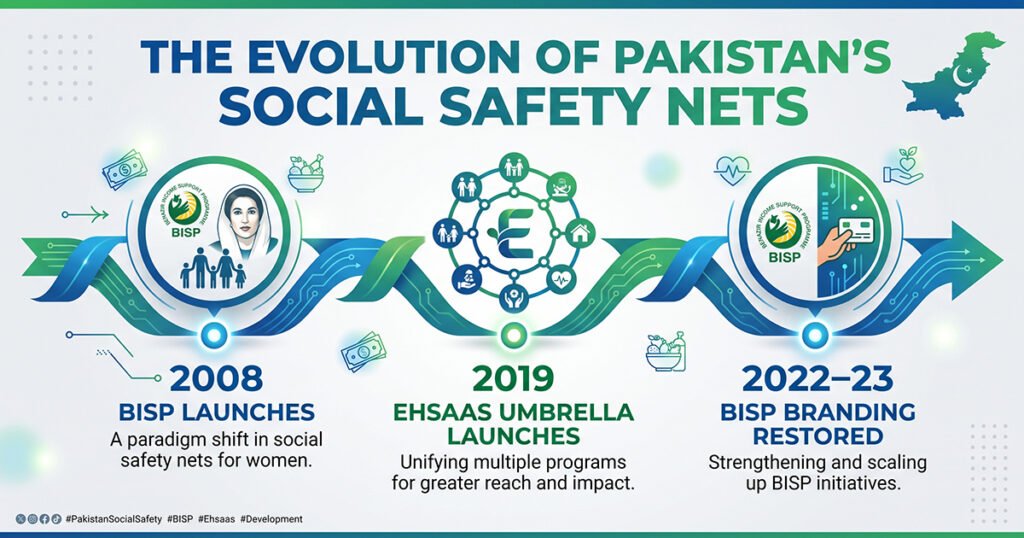
The Benazir Income Support Programme launched back in 2008 under the PPP government, named after Benazir Bhutto. For a decade, “BISP” was the only name attached to Pakistan’s flagship cash transfer programme.
Why the Ehsaas Kafalat name appeared in 2019
That changed in 2019, when the PTI government under Prime Minister Imran Khan launched an umbrella initiative called “Ehsaas” (Urdu for “compassion”). Rather than replacing BISP as an institution, Ehsaas became a branding layer over several existing and new programmes. The monthly stipend previously known simply as BISP’s cash transfer was rebranded “Ehsaas Kafalat” (also written “Kifalat”), and new initiatives — such as Ehsaas Emergency Cash during the COVID-19 pandemic — launched under the same umbrella.
Why BISP Kafalat 2026 is the name used now
Following the 2022–23 change in government, the Ehsaas branding was phased out at the administrative level and the BISP name was restored as the primary umbrella. That is why the stipend is documented everywhere as BISP Kafalat 2026 today. The underlying institution never stopped existing during the Ehsaas years; only the public-facing branding shifted back and forth.
What Actually Changed in BISP Kafalat 2026 (Branding, Not Criteria)
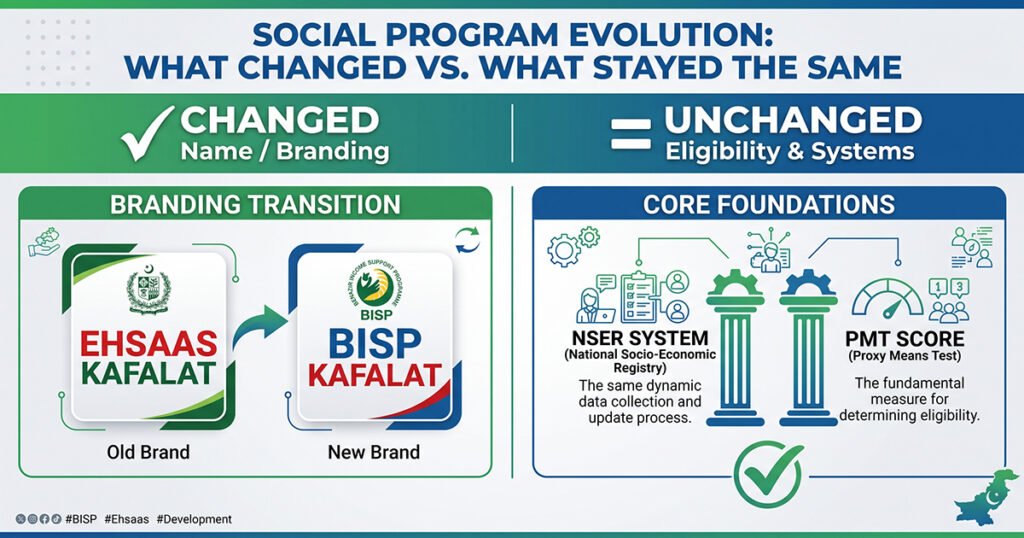
Here is the part that settles most of the Ehsaas Kafalat vs BISP Kafalat confusion: the rebrand was a naming and administrative change, not a change to who qualifies or how.
- Eligibility stayed on the same PMT/NSER framework throughout both branding periods — the poverty scoring method was not reset by the name change. If you are unsure where you stand, read what a PMT score is and how the NSER registry works.
- The underlying institution remained BISP as a legal entity even while “Ehsaas” was the public umbrella name from 2019 to 2022.
- Sub-programme names shifted with the branding — what was called “Ehsaas Kafalat” between 2019 and 2022 is the same stipend now referred to as Kafalat or BISP Kafalat 2026.
- Other Ehsaas-era sub-programmes continued too — Taleemi Wazaif (education stipend) and the Benazir Nashonuma nutrition programme both carried through the transition under their existing names.
- Payment amounts kept rising on the BISP schedule, not the Ehsaas one — see the current BISP installment amount and payment schedule for 2026.
So if you were checking “Ehsaas eligibility” a few years ago and now see “BISP eligibility,” you are almost certainly looking at the same database and the same programme under its current name. If the details on your record are out of date, that is fixed through the BISP dynamic survey and NSER record update — not by registering again under a new brand.
Is Ehsaas Still Active in 2026?
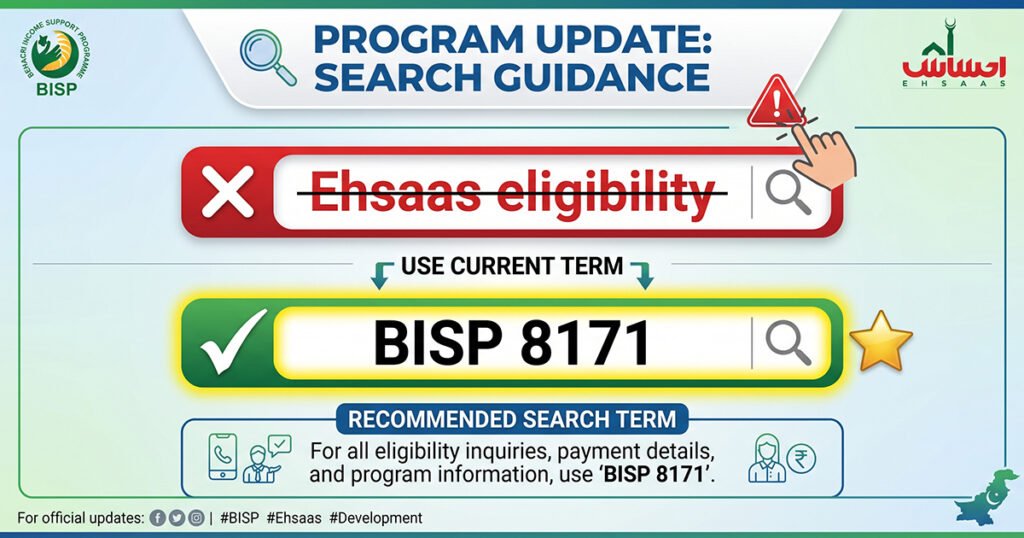
Asking is Ehsaas still active deserves a nuanced answer. The “Ehsaas” branding is no longer the primary public name used by the government, but the programmes it covered — Kafalat, Taleemi Wazaif and Nashonuma — are all still running under BISP. So is Ehsaas still active as money you can actually receive? Yes, but you will find it under the name BISP Kafalat 2026.
What being active really means for Ehsaas Kafalat holders
Practically, here is what that means when you go looking for your payment:
- Search for “BISP” or “8171”, not “Ehsaas”, when you want the official eligibility check tools.
- The 8171 web portal and SMS service are the current official channels — the 8171 SMS check works from any basic phone, with no internet needed.
- Old Ehsaas-branded documents and cards are still generally valid as proof of your enrolment history, even though new communications carry BISP branding.
- If you registered years ago under “Ehsaas,” your record did not disappear — it carried forward into the current database under the same CNIC. Confirm it with the 8171 CNIC check.
You can confirm the current programme names and official announcements on the official BISP website at bisp.gov.pk.
How to Check Your BISP Kafalat 2026 Status Step by Step
Whichever name you knew the programme by, the check itself takes about a minute:
- Open the 8171 web portal in any browser.
- Type your 13-digit CNIC number without dashes or spaces.
- Enter the captcha code shown on the screen.
- Press the check button. The result tells you whether you qualify for BISP Kafalat 2026 and what your current payment status is.
- No internet? Send your CNIC number in a plain SMS to 8171 and wait for the reply message.
- If the portal reports your CNIC was not found, work through the 8171 CNIC not found fix.
If your BISP Kafalat 2026 check does not work
If the portal shows you as eligible but the money has not arrived, the guide on what to do when your BISP payment is not received covers the usual causes. To confirm the exact instalment that has been released against your CNIC, use the 8171 payment status check.
Which Ehsaas Programmes Carried Over Into BISP Kafalat 2026
The Ehsaas umbrella covered more than one scheme, and the Ehsaas Kafalat vs BISP Kafalat question really applies to all of them. Here is how the main sub-programmes map from their Ehsaas-era names to the names in use alongside BISP Kafalat 2026 today.
| Ehsaas-era name | Name used now | What it provides |
|---|---|---|
| Ehsaas Kafalat | BISP Kafalat 2026 | The main quarterly cash stipend for eligible women |
| Ehsaas Taleemi Wazaif | Benazir Taleemi Wazaif | Education stipends tied to children’s school attendance |
| Ehsaas Nashonuma | Benazir Nashonuma | Nutrition support for mothers and young children |
| Ehsaas Emergency Cash | Closed | One-off COVID-era relief, not a running scheme |
| Ehsaas Survey / NSER | BISP Dynamic Survey | The household survey that produces your PMT score |
Two things are worth noticing in that table. First, only one programme actually ended, and it ended because the emergency it was created for ended — not because of the rebrand. Second, the survey that feeds every one of these schemes is the same one it always was, which is why a household enrolled under Ehsaas does not need to start again to receive BISP Kafalat 2026.
Who Qualifies for BISP Kafalat 2026?
Because the criteria travelled through the rebrand untouched, the rules that decided an Ehsaas Kafalat payment are the rules that decide a BISP Kafalat 2026 payment. Eligibility is not judged case by case at a counter — it is calculated from your household’s survey data.
The core requirements
- A completed NSER survey. If your household has never been surveyed, or the record is many years out of date, there is nothing for the system to score. This is the single most common reason a CNIC returns nothing.
- A PMT score below the eligibility cut-off. The Proxy Means Test converts your household details — family size, assets, housing, education, earners — into one number. Lower means poorer, and below the published threshold means eligible.
- A valid, unexpired CNIC. The stipend is paid to a named woman in the household, and an expired or blocked CNIC will stop a payment even when the household still qualifies.
- Registration in the woman’s own name. Kafalat has always been paid to a female head of household or a nominated woman within it, both under Ehsaas branding and under BISP Kafalat 2026.
What usually disqualifies a household
- A member in regular government employment, or drawing a government pension.
- A household that files income tax, or that shows a taxable income on record.
- Ownership of a vehicle, substantial land, or other assets recorded in the survey.
- Recent international travel on the applicant’s record, which the system reads as a sign of means.
- Data that no longer reflects reality — this cuts both ways, which is why an out-of-date record is worth correcting through the dynamic survey rather than leaving alone.
None of these bars is new. They applied under Ehsaas Kafalat and they apply to BISP Kafalat 2026, which is a useful reminder that the name on the guidance you are reading matters far less than how recent it is.
How BISP Kafalat 2026 Payments Are Delivered
Delivery is the other area where people expect the rebrand to have changed something, and again it largely has not. Payments are released in quarterly instalments and collected in person after biometric verification.
- Campsites. Temporary payment camps set up in a district when an instalment is released, staffed to handle fingerprint verification on the spot.
- Partner bank branches and agents. Payments are routed through the partner banks appointed for the region, and their authorised agents.
- Retailer points. Approved shops and franchise counters that can complete a biometric payout in areas without a nearby branch.
Biometric verification is the constant across all three. If a fingerprint does not read — a common problem for older women and for anyone doing manual work — the payment is not refused, but it will need a repeat attempt or a visit to a BISP tehsil office. It is also the reason nobody should ever hand a CNIC and a thumbprint to an agent who offers to collect a BISP Kafalat 2026 payment on their behalf for a cut.
Enrolled Under Ehsaas but Not Being Paid?
This is the situation that sends most people looking up Ehsaas Kafalat vs BISP Kafalat in the first place: money that used to arrive has stopped, and the change of name looks like the obvious culprit. It rarely is. Work through these in order before assuming your entitlement was cancelled.
- Check the status yourself first. Run your CNIC through the 8171 portal or SMS service. The reply tells you whether the system still holds you as eligible for BISP Kafalat 2026, which immediately separates a data problem from a payment problem.
- Confirm your CNIC is current. An expired CNIC is the most common single cause of a stopped payment, and it is fixed at NADRA rather than at BISP.
- Check whether your survey record aged out. Household circumstances get re-surveyed, and a record that has not been updated in years can push a PMT score out of range on stale data.
- Look at whether an instalment has actually been released. Quarterly schedules mean a gap of weeks is normal, and “not yet released” is not the same as “no longer eligible”.
- Visit a tehsil office if the portal and the reality disagree. Take your CNIC. Complaints registered in person carry a reference you can follow up on, which an agent’s promise does not.
Asking is Ehsaas still active is understandable when a payment stops, but the answer almost never explains the gap. A record that needs updating, a CNIC that needs renewing, or an instalment that has not been released yet accounts for the overwhelming majority of cases, and all three are fixable without losing your place in BISP Kafalat 2026.
Common Mistakes When Searching for Ehsaas Kafalat
Most of the trouble people run into is not with eligibility at all — it is with finding accurate information in the first place. These are the patterns worth avoiding.
- Reading Ehsaas-era guidance as current. An article written in 2020 may describe amounts, portals and offices that have all moved on. Check the date before you trust the detail.
- Assuming a new name means a new registration. It does not. Registering twice creates duplicate records and slows your case down.
- Trusting portals that are not the official one. Sites that ask for a fee, a bank PIN or an OTP to “check Ehsaas eligibility” are not running an eligibility check.
- Searching only for “Ehsaas”. You will surface older pages first. Searching for BISP or 8171 brings back current guidance on BISP Kafalat 2026 instead.
- Paying an agent to confirm status. The 8171 SMS and web check are free, and no agent has access to a queue you do not.
Key Takeaways: Ehsaas Kafalat vs BISP Kafalat
- They are the same programme. “Ehsaas Kafalat” was the brand between 2019 and 2022; BISP Kafalat 2026 is the same stipend under the restored name.
- Nothing about your eligibility was reset by the rebrand — the PMT score and NSER record carried straight through.
- Asking is Ehsaas still active is really asking whether the programmes survived the rebrand, and they did, under BISP.
- Use BISP or 8171 as your search terms, and treat pre-2023 pages as historical background rather than instructions.
- If a check comes back empty, the fix is almost always an outdated or missing survey record, not a lost entitlement.
3 thoughts on “Ehsaas Kafalat vs BISP Kafalat 2026: Is Ehsaas Still Active?”