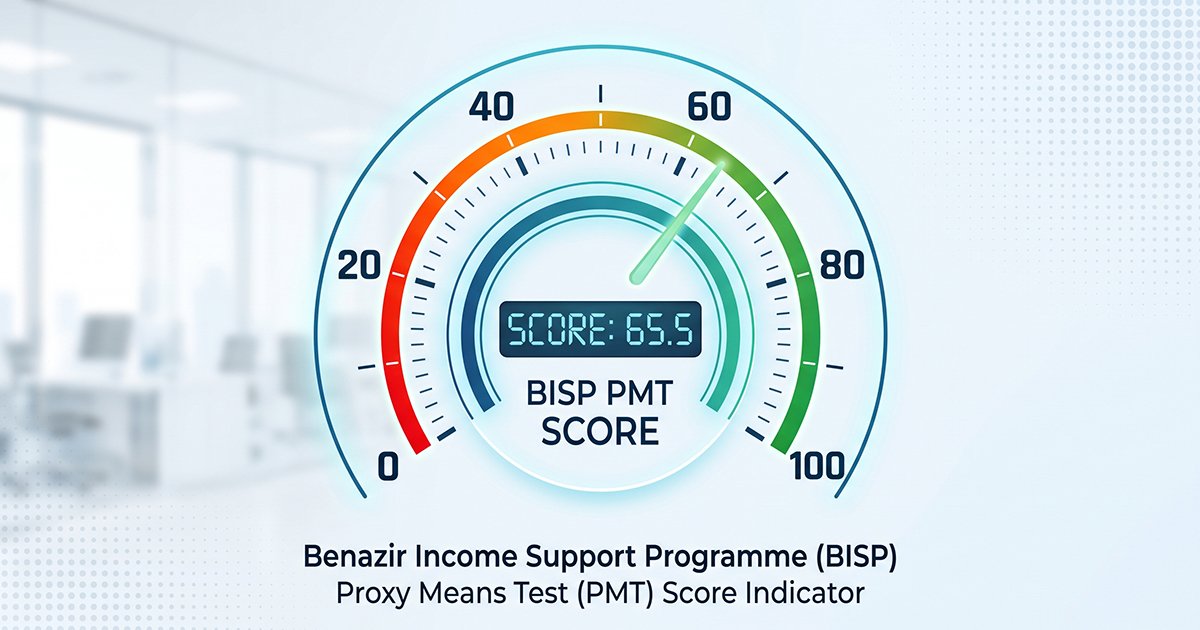
Most guides mention “PMT below 32” and move straight to eligibility rules, leaving the score itself unexplained. If you have ever wondered what is PMT score, why the PMT score BISP uses can differ for two families with almost identical incomes, or how an NSER registry check changes it, this 2026 guide gives the plain-language answer that usually gets skipped.
Quick answer: your BISP PMT score is a single poverty number between 0 and 100, the Benazir Kafalat cutoff sits near 32 points, and the only reliable way to change it is a fresh NSER registry check. Everything below explains those three points step by step.
What Is PMT Score? A Simple Definition
PMT stands for Proxy Means Test. In simple terms, it is a scoring method the government uses to estimate how poor a household is without verifying every rupee of income directly, because self-reported income in Pakistan is often unreliable, seasonal or simply undocumented.
So what is PMT score in practice? It is a single number, calculated for every surveyed household, that acts as a proxy for the family’s real economic condition. Instead of asking “how much do you earn”, the PMT method looks at observable, harder-to-fake details — housing quality, assets owned, family structure and more — and combines them into one figure on a scale of roughly 0 to 100.
The lower the number, the poorer the household is estimated to be. That number is the PMT score BISP uses to decide who qualifies for Benazir Kafalat and the related cash transfer programmes. You can see the outcome of that decision for your own family through an 8171 CNIC check.
What Is PMT Score Compared to the Poverty Scorecard?
People often use the two terms interchangeably, and that causes confusion. The Poverty Scorecard is the survey — the questionnaire an enumerator fills in at your door. The PMT score is the result — the number the formula produces from those answers. So when someone asks what is PMT score in relation to the scorecard, the short answer is that one is the input and the other is the output. The PMT score BISP staff see on screen is always the calculated output, never the raw questionnaire.
The 32-Point PMT Score BISP Threshold Explained
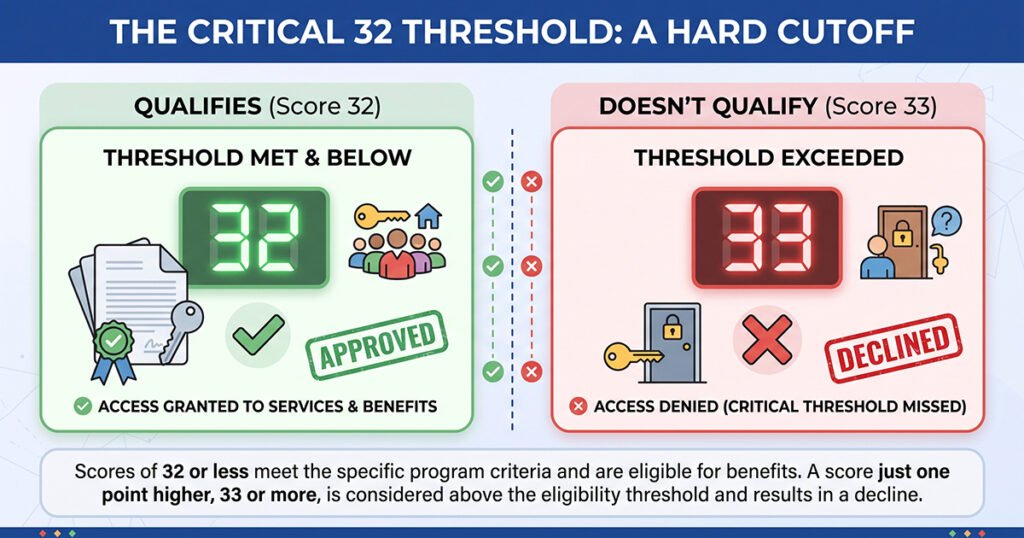
The table below shows how each PMT score BISP band is normally read in practice. BISP sets a cutoff score, and households at or below that cutoff qualify for the Kafalat programme. Through 2026 the cutoff has generally sat around 32 points, though the exact figure can shift slightly between programme cycles based on budget and policy decisions announced by the Benazir Income Support Programme.
| PMT score range | What it usually means in 2026 |
|---|---|
| 0 – 20 | Deep poverty. Clearly inside the Kafalat band, and usually flagged for priority programmes such as Nashonuma. |
| 21 – 32 | Eligible band. At or below the cutoff, so the household normally qualifies for Benazir Kafalat. |
| 33 – 40 | Just above the line. Not eligible on score alone, but a genuine change in circumstances can move it. |
| 41 – 60 | Moderate. A re-survey rarely changes the outcome unless the household situation has changed sharply. |
| Above 60 | Not eligible. The registry records assets or income indicators well above the poverty band. |
Here is the part that trips people up: the cutoff is a hard line, not a soft guideline. A household scoring 32 qualifies. A household scoring 33 does not, even though the two are nearly identical in real economic terms. This is a known limitation of proxy-based scoring systems worldwide, not something unique to Pakistan, but it is exactly why some genuinely struggling families narrowly miss out while a neighbour just under the line receives payments.
Some vulnerable groups — widows, or households with a disabled member — may be considered under separate provisions even when the PMT score BISP recorded for them sits close to the line, so a score slightly above the cutoff does not always mean the door is closed.
How the BISP PMT Score Is Calculated
The formula draws on data collected through the National Socio-Economic Registry — the same database behind every NSER registry check, built from door-to-door Poverty Scorecard Surveys carried out by BISP field teams. Enumerators record specific, observable details rather than relying on a family’s own income estimate.
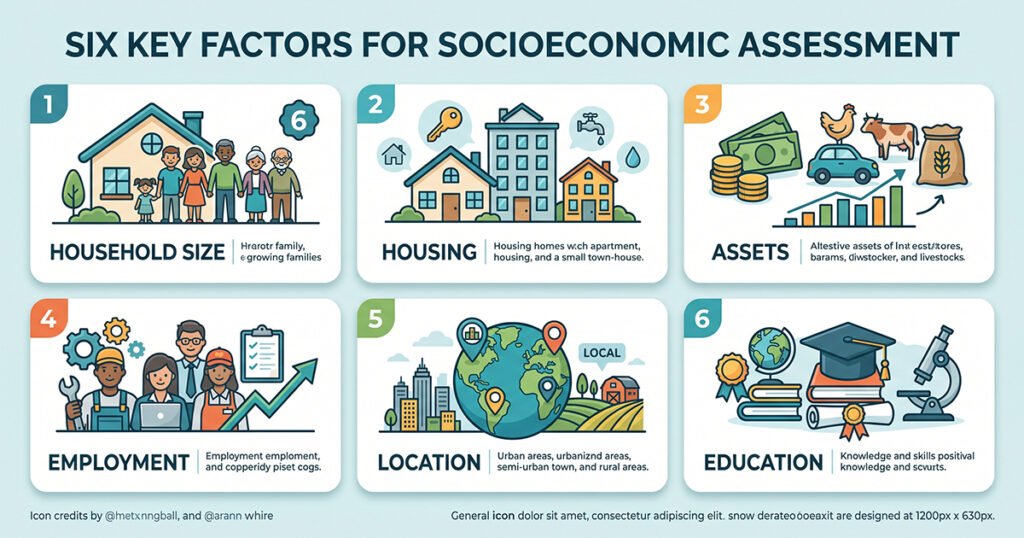
Factors that typically feed into the score include:
- Household size and dependency ratio — the number of dependents relative to working-age adults.
- Housing and living conditions — construction material, roof type, and access to electricity, water and sanitation.
- Asset ownership — vehicles, agricultural land, livestock, refrigerators, air conditioners and other durable assets.
- Employment status — whether any household member holds a government post or a stable private-sector job.
- Geographic location — urban versus rural setting, with adjustments for regional cost-of-living differences.
- Education and literacy indicators — in some formula versions adult literacy is factored in as a proxy for economic opportunity.
Each input is weighted and combined into the final figure. Because the formula is statistical rather than a simple checklist, you cannot work out the PMT score BISP holds on record for your family by hand — the only accurate route is the official registry or a status check.
Which Factors Move the Score the Most?
Field experience suggests three inputs carry the heaviest weight in practice. A government job in the household is close to decisive, because it signals steady documented income. Ownership of a vehicle or a substantial piece of land is the second. Housing construction — pukka versus kacha — is the third. Smaller items such as a mobile phone or a fan barely move the needle, which is why the answer to what is PMT score is never “a list of things you own” but rather “a weighted statistical estimate”. Two neighbours with the same furniture can still end up on opposite sides of the PMT score BISP cutoff for exactly this reason.
NSER Registry Check: Where Your PMT Score Comes From
An NSER registry check tells you whether your household is registered in the national registry, roughly when it was last surveyed, and whether the record behind your score is current. Because the score is only as good as the data feeding it, an outdated record is the single most common reason a genuinely poor household shows a high PMT score.
The registry was rebuilt in the national re-survey and is now maintained continuously through the dynamic survey system, so an NSER registry check today reflects a live record rather than a one-off snapshot from years ago.
How to Do an NSER Registry Check in 2026
- Send your 13-digit CNIC number, without dashes, in an SMS to 8171 and wait for the automated reply.
- Open the official 8171 web portal, enter the same CNIC and type the captcha code shown on screen.
- Read the status message carefully. It confirms whether you are registered and eligible, based on the PMT score BISP currently has on file for your household.
- If the record looks outdated or the details are wrong, visit your nearest BISP Tehsil office with your original CNIC to request a fresh survey.
- Repeat the NSER registry check about four to six weeks after the survey visit to see the updated result.
Our step-by-step 8171 payment status check guide walks through the portal screens if you get stuck, and the BISP Dynamic Survey guide covers the record update process in full.
Can You Dispute or Improve Your PMT Score BISP Result?
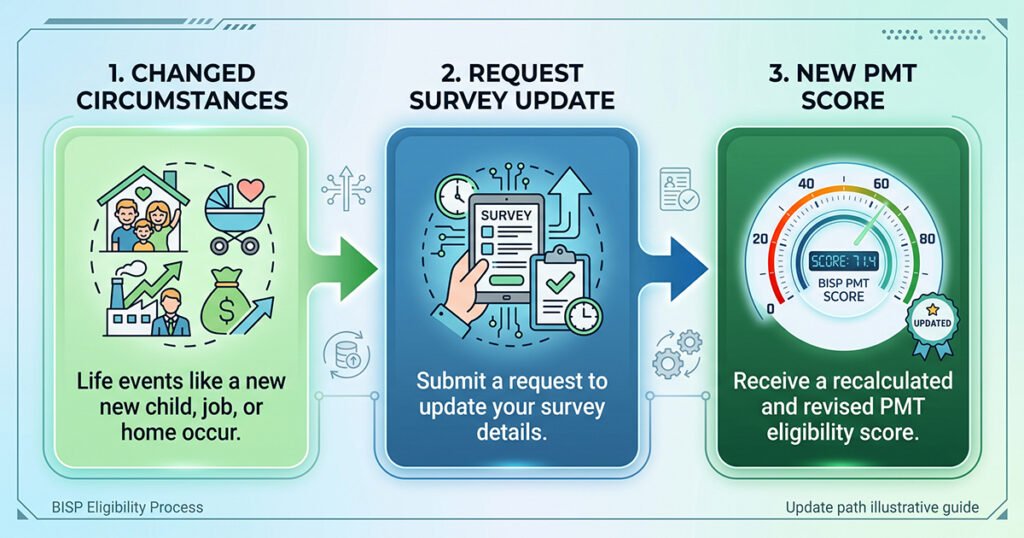
A PMT score BISP result is not necessarily final. There are two realistic paths if you believe the number does not reflect your actual situation:
- Request an updated survey. If your household circumstances have genuinely changed — a lost job, a new dependent, a move to poorer housing — a fresh NSER registry check and re-survey can produce a more accurate score. This is not disputing the formula; it is correcting outdated input data.
- Report a data entry error. If the details recorded during your survey visit were simply wrong (household size, assets you do not own, a job nobody holds), visiting a BISP Tehsil office to flag the discrepancy can trigger a correction.
What you cannot do is appeal the formula itself or ask for the cutoff to be adjusted for your individual case. The system is designed to apply consistently across every household in the country, so the practical path forward is always accurate, current data rather than a case-by-case negotiation.
How Long Does an Update Take?
Nothing in the PMT score BISP system updates instantly. In most districts a requested re-survey is scheduled within a few weeks, and the recalculated figure appears in the registry roughly one to two months after the enumerator’s visit. Payments, if you become eligible, follow the next disbursement cycle rather than starting immediately. If your status changes but no money arrives, our guide on what to do when a BISP 8171 payment is not received covers the usual causes.
Common Myths About the PMT Score BISP System
- “An agent can lower my score for a fee.” No one outside BISP can edit the registry. Anyone charging for this is running a scam — every step described here is free.
- “Buying a phone raised my score above 32.” Small consumer items carry very little weight. Large assets and documented employment are what move the figure.
- “Once ineligible, always ineligible.” Untrue. A fresh NSER registry check after a real change in circumstances can produce a different PMT score BISP result.
- “There is an online PMT calculator.” There is not. Any site claiming to compute the PMT score BISP assigns you is guessing.
PMT Score BISP: Key Points to Remember
- What is PMT score? A 0 to 100 poverty estimate produced by the Proxy Means Test formula, where lower means poorer.
- The cutoff. Households at or below roughly 32 points fall inside the Benazir Kafalat band in 2026.
- Where it comes from. The National Socio-Economic Registry, which is why an NSER registry check is the first thing to run.
- How to change it. Only through a fresh survey or a corrected record — never through a fee, an agent or an app.
- What it does not guarantee. A qualifying PMT score BISP result still needs biometric verification and a valid CNIC before payment begins.
Understanding how the PMT score BISP system works is the first step; acting on it is the second. Once your score qualifies, the same registry feeds the other programmes: see our guides to the Benazir Nashonuma Program and to BISP Kafalat vs Ehsaas Kafalat for what your household can claim next.
7 thoughts on “What Is PMT Score in BISP? (Explained Simply)”